How to design a disc golf course
A good disc golf course is mostly decided before a single basket goes in the ground: where the holes run, how they connect, and what is downrange of every throw. This guide walks through the whole process — the same one clubs use when they build a new course in a park, a school ground or a forest — in the order the decisions actually have to be made.
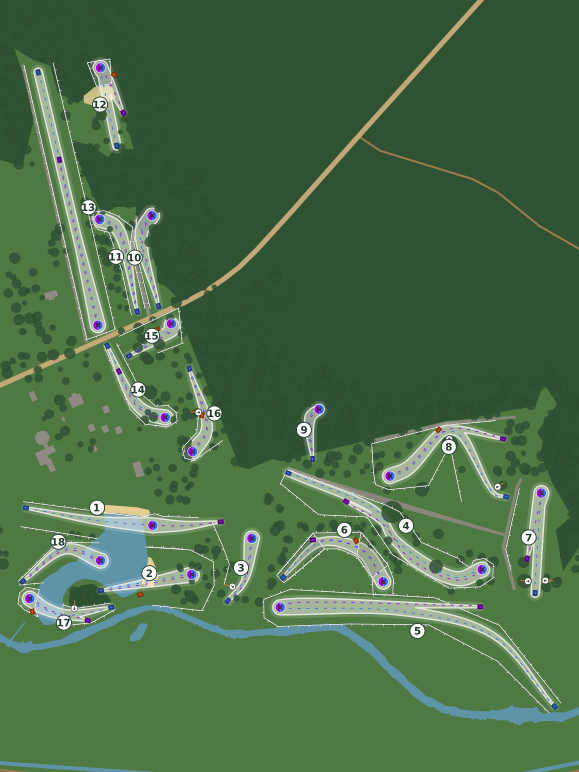
1. Start with the land and the landowner
Before any design work, find out what you are allowed to do and where. Most courses sit on public land, so the first conversation is with the city, the parks department, the school or the forest manager. Ask early about the things that will shape the layout: areas that must stay untouched (playgrounds, sports pitches, protected trees, wetlands), whether permanent tee pads may be poured, who mows, and who is liable if someone gets hit.
As a rough rule of thumb, a full-length course needs about one to two acres (0.4–0.8 ha) per hole, so 18 holes want something like 20–40 acres (8–16 ha). A tight 9-hole course for beginners, a school or a short tournament layout can fit in much less, especially with wooded holes that keep discs on line. Dense woods hold more holes per hectare than open grass, because trees stop errant throws; open fields need more space between fairways.
2. Walk the site and map what is there
Walk the whole property several times, at different times of day. Note the things that make holes interesting — elevation changes, gaps in the trees, a pond, an isolated big tree — and the things that make them dangerous: paths, roads, car parks, benches, buildings and anywhere people gather. Mark the natural places for a first tee (near parking and a course sign) and for a last basket (back near the start).
A satellite map is the best base for this. Drawing candidate tees and baskets on real coordinates shows immediately whether a 90 m hole actually fits between two paths, and how far the walk to the next tee really is.
3. Design for safety first
Every hole has a landing zone — where most drives come down — and a fan of bad throws around it. The single most important rule is that neither may cover a path, road, parking area or another hole's tee. Discs thrown by stronger players travel much further than a recreational layout suggests, and a disc that skips on hard ground keeps going.
- Do not let fairways cross, and do not aim a hole at another hole's tee or basket.
- Keep generous buffers between landing zones and anything with people on it; give more room downhill and on the side a typical right-handed backhand fades to.
- Put the next tee behind or beside the previous basket, never in front of it, so players walking up are not in the line of fire.
- Avoid blind throws over the crest of a hill onto a public path; if a hole must be blind, put a spotter's warning on the sign.
- Check the sun: east-facing holes early in the round and west-facing ones late in the day blind players.
4. Route the course
Routing is the order in which the holes join up. Good routing feels like a walk through the property: each basket leads naturally to the next tee, a short distance away and in a different direction. The best courses use the land's features once each, at the moment they will have the most effect, rather than repeating the same kind of hole three times in a row.
- Begin near parking and a course map board; end near the start — on an 18-hole course ideally with hole 9 returning close by too, so players can play a shorter round.
- Keep the walk from basket to next tee short; long walks slow every group down and make players cut across other holes.
- Change direction from hole to hole so wind and sun do not favour the same throw all round.
- Leave room around the first tee for groups to wait without standing in anyone's line.
5. Mix lengths, shapes and par
Variety is what makes a course worth replaying. Mix short, technical holes with open ones where players can throw hard; holes that turn left (a hyzer for right-handed backhand throwers) with ones that turn right; uphill with downhill; open with wooded. Several tee layouts per hole — for example a short tee and a long tee — let the same course serve beginners and experienced players.
Most recreational holes are par 3 between roughly 50 and 100 m (165–330 ft). Longer holes, or holes with a forced lay-up around water or a dogleg, can be par 4 or 5. Par should reflect what a skilled player for that layout needs, not just the raw distance: a 110 m hole through a narrow gap may still be a hard par 3, and an open downhill 120 m hole may play easier than a wooded 80 m one.
6. Place tee pads and baskets
A tee pad needs flat, level, non-slip footing long enough for a run-up — around 1.5 m wide and 3–4 m long (roughly 5 × 10–12 ft) is common, made of concrete, artificial turf or compacted gravel. Point it straight down the intended line so players are not fighting the pad.
Put baskets on reasonably flat ground so putts that miss do not roll far away, and keep them clear of anything a disc could damage or be lost in unless that is the deliberate challenge of the hole. Where the ground allows, plan two or three basket positions per hole and rotate them: it keeps the course fresh and spreads the wear.
7. Test before you install
Mark every tee and basket position with flags or temporary baskets and throw the course with players of different skill levels. Watch where discs actually land, not where you hoped they would. Expect to move several holes: a gap that looked obvious on the map may be too tight, or a landing zone may be closer to a path than it seemed. Only when the layout survives a few rounds of testing is it time to pour tee pads and set baskets in concrete.
- Flag candidate tees and baskets on the ground.
- Throw each hole with beginners and with strong players.
- Mark real landing zones and any throws that reach paths or other holes.
- Adjust, re-measure and re-test until the layout is safe and fun.
- Install permanent tee pads, baskets and signs.
8. Sign it and keep it up
A new player needs a course map board at the first tee and a tee sign on every hole with its number, par, distance and a map of the line, including OB and mandatory routes. A short local-rules section on the board — what is out of bounds, where the drop zones are — prevents most arguments on the course.
Courses change after opening: grass wears away in front of tee pads, a fairway needs a branch cut back, a basket gets moved. Keep the master map up to date, so that new signs and the course page always match what players find on the ground.
Doing the design work in DiscMap
DiscMap was made for steps 2 to 8. You place tees and baskets on a satellite map, draw flight lines, OB and mandos, and see measured distances for every layout as you go. Moving a basket during testing updates the distances, the course map and every tee sign at once, and when the layout is final you export print-ready signs, a course board and a caddie book. It is free and needs no account.
Questions
- How much land do I need for a disc golf course?
- A common rule of thumb is one to two acres (0.4–0.8 ha) per hole for a full-length course, so roughly 20–40 acres for 18 holes. Wooded land fits more holes per hectare than open grass; a short beginner or school course can work on much less.
- How long should disc golf holes be?
- Most recreational par 3 holes are between about 50 and 100 m (165–330 ft). Longer holes or ones with forced lay-ups can be par 4 or 5. Variety matters more than any single number.
- How many holes should a course have?
- 9 and 18 are the standard. A 9-hole course with two tee layouts per hole can be played as 18 and is often the best use of a smaller site.
- What is the most common design mistake?
- Underestimating how far bad throws travel. Landing zones that overlap paths, roads or other holes are the main reason courses have to be redesigned after opening, so test with strong players before installing anything permanent.